
A significant number of patients postpone treating their hearing loss because they harbor concerns regarding device aesthetics and physical comfort. For decades, legacy acoustic amplifiers were cumbersomely large, highly conspicuous, and culturally tethered to physical senescence. In various scenarios, patients expressed fear that wearing an obvious device would cause peers to omit them from casual conversations due to perceived listening limitations.
Because this archaic mental image endures, thousands remain deeply reluctant to schedule an initial audiometric evaluation. However, contemporary medical engineering has ensured that current hearing solutions look and function in a completely unexpected manner. Thanks to rapid technological evolution, modern devices are remarkably downsized, highly ergonomic, and exceptionally covert.
If cosmetic anxiety has caused you to delay treating your hearing loss, it is highly recommended that you evaluate the sophisticated options now available.
Why the Bulky, Obvious Hearing Aid Is a Thing of the Past
When asked to visualize a hearing instrument, the average person still envisions an awkward, highly conspicuous piece of hardware visible from yards away. If that is the visual you hold, you are fundamentally remembering outdated medical equipment from decades past.
In the intervening decades, the entire field of otolaryngology and acoustic engineering has undergone a massive paradigm shift. Unprecedented breakthroughs in microchip architecture, material sciences, and digital signal processing have utterly revolutionized modern aesthetics. Today’s instruments are profoundly smaller, remarkably streamlined, and strategically engineered to blend flawlessly into your natural anatomy or vanish altogether.
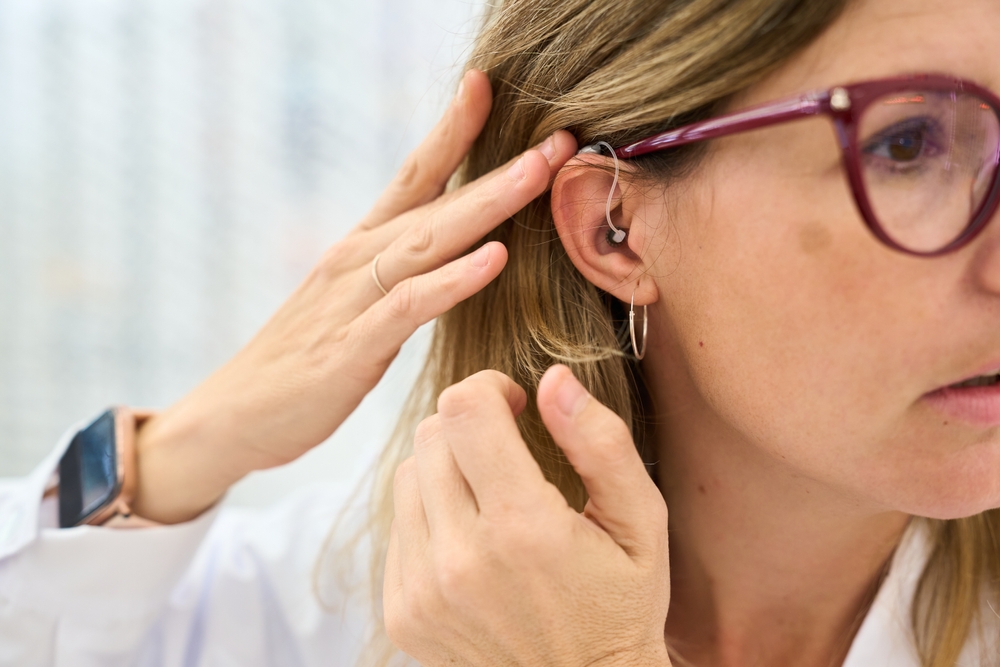
A multitude of current designs fit entirely inside the physical ear canal, ensuring they remain hidden from view during normal social encounters. Others rest behind the ear but are so compact and lightweight that they’re easy to overlook, especially when matched to your hair or skin tone.
Primary Hearing Aid Styles, From Invisible to Barely There
To understand how these sophisticated medical devices are physically configured, review this concise anatomical breakdown:
Invisible-in-Canal (IIC) Technology
This tier represents the absolute pinnacle of cosmetic concealment. The IIC style fits exclusively within the deep internal canal and is built using a custom impression of the patient’s ear passagographic anatomy. Spoken interactions at arm’s length occur without anyone realizing a medical device is present. They’re a popular choice for people with mild to moderate hearing loss who prioritize subtlety.
Receiver-in-Canal (RIC) and Receiver-in-the-Ear (RITE) Designs
This is the most common style today. A micro-housing rests behind the upper pinna, transferring processed sound via an ultra-fine, translucent micro-wire to an acoustic driver nestled inside the canal. At a glance, they often resemble wireless earbuds. Most people won’t notice them unless they’re looking.
Power and Performance: Behind-the-Ear (BTE)
These sit fully behind the ear and are slightly larger, but they’re still far more streamlined than older versions. Frequently utilized to remediate severe-to-profound auditory loss, they maximize gain and processing capability while maintaining a highly professional, low-profile aesthetic.
The key takeaway: Today’s discreet hearing aids are designed to fit your life, not announce themselves.
Modern Hearing Aids: Looking Better and Doing a Lot More
The recent metamorphosis of hearing instruments extends far beyond mere cosmetic downsizing. Today, they function more like smart devices than traditional medical equipment. A vast majority feature native Bluetooth connectivity, enabling seamless, wireless streaming of telephonic communication, media, and television audio directly into your auditory pathway.
Most come with smartphone apps, so you can adjust volume or switch settings without ever touching the device. Say you’re walking into a noisy restaurant: You can fine-tune your hearing to match the environment in seconds. Furthermore, lithium-ion rechargeable cells have entirely eliminated the need to fiddle with microscopic, short-lived zinc-air batteries. The process is as simple as placing the units into their charging dock each night, identical to charging your cell phone.
Getting Over the Fear and Stigma of Hearing Devices
Even knowing all of this, it’s easy to hesitate. Initiating an auditory health journey can feel emotionally taxing because it requires acknowledging that our physical baseline has shifted over time. This mental hurdle can make an individual feel exposed, creating a false impression of losing authority over personal wellness.
Consider a healthier perspective: wearing a contemporary hearing system does not mean your body has failed you. They are merely an intelligent adaptation to a universal milestone of aging that impacts us all eventually. Adopting this tech is definitive proof that you are actively taking charge of your health to empower and protect your daily cognitive function.
Imagine wearing a discreet, barely (if at all) visible device and finally being able to follow along in conversation, hear better in crowds, and focus on the things that really interest you. This is the definition of true personal empowerment!
Experience Contemporary Hearing Technology Firsthand
The quickest way to erase your grandfather’s mental model is to physically interact with twenty-first-century hearing tech. We encourage you to drop by our office, address your concerns, and hold these miniature devices yourself with zero sales pressure. View this consultation simply as a tactile opportunity to discover just how radically changed this technology has truly become.
Almost every visitor walks out completely shocked by how weightless, ergonomic, and cosmetically invisible these tools are in practice! Call our office to schedule your visit online today.