Active restaurant conversations are frequently hard to decipher when surrounding background noise clashes with your hearing. Our specialists can evaluate hearing under both calm and noisy listening conditions to establish why noisy rooms present such difficulty. Once we determine the cause of difficult hearing, we can help you find personalized solutions.
Understanding the Contrast Between Quiet Hearing and Restaurant Noise
A quiet setting creates an optimal signal-to-noise ratio, ensuring the conversational partner’s voice rises cleanly above ambient sounds. Dining rooms present an unfavorable acoustic reversal of this dynamic. Cross-talk, ambient music, dishware noise, and harsh acoustic reverberation interfere with speech clarity, forcing your brain to labor to extract the target voice.
These communication barriers frequently indicate high-frequency hearing loss, central auditory-processing disorders, or age-related sensorineural changes. Visual limitations from low lighting, cognitive fatigue, and sitting farther away from conversational partners amplify speech degradation. Certain patients demonstrate normal sensitivity on routine audiograms while struggling significantly during advanced speech-in-noise testing. Inability to track speech in crowded restaurants merits audiological evaluation even when standard daily hearing sounds completely normal.
The Audiological Process for High-Frequency Hearing Loss
The diagnostic workup opens with an extensive intake examining difficult listening environments, past noise trauma, tinnitus presence, family history, and medical history.
Pure-tone audiometric evaluations measure the absolute quietest sounds audible across specific octave frequencies using air and bone conduction. Sensorineural high-frequency hearing loss demonstrates an audiometric slope reflecting diminished hearing thresholds as sound frequencies climb. Supplementary assessments routinely include diagnostic tympanometry to analyze middle-ear status alongside word-recognition testing to determine speech clarity.
A quiet sound booth cannot replicate complex dining room acoustics, which makes clinical speech-in-noise testing especially informative. It calculates your ability to identify verbal phrases as competing background noise levels rise. Together, these results show whether the problem involves audibility, speech clarity, background-noise processing, or a combination of factors.
How Do Auditory Processing Disorders Affect Hearing in Adults?
Auditory processing disorders interfere with the brain’s ability to process and decipher acoustic signals arriving from the ears. While peripheral ears may register soft tones normally, the auditory cortex struggles to filter competing noise, resolve phonetic contrasts, or keep pace with rapid conversation. Our protocol begins by thoroughly testing peripheral hearing before determining if a specialized central auditory-processing battery or interdisciplinary referral is warranted.
What Strategies Can Improve Hearing in Noisy Environments?
Simple situational adjustments enhance the speech signal entering your ears and offer clearer facial cues. Before heading out to eat, select dining spots with quieter acoustic profiles or dine during low-volume hours. Facilities equipped with upholstered booths, acoustic baffles, fabric curtains, carpeted floors, and soft materials prove far easier on hearing than minimalist, hard-tiled spaces.
Practical seating strategies in the dining room:
- Request a table away from the kitchen, bar, speakers, and large groups.
- Sit with a perimeter wall directly behind you to cut down on ambient noise approaching from the rear.
- Position yourself to directly face companions under bright lighting to enhance facial comprehension.
- Keep the distance between speakers as short as comfortably possible.
- Angle your stronger-hearing ear toward the primary individual you wish to converse with.
- Request that companions rephrase misunderstandings using different words rather than repeating the same sentence.
- Confirm important details rather than pretending to understand.
- Step away for a brief auditory rest when cognitive listening fatigue begins to set in.
- Ask dinner guests to speak with clear enunciation at a steady, natural conversational rate.
- Shouting creates acoustic distortion that actively compromises speech understanding rather than helping.
The Best Hearing Devices for Overcoming Restaurant Noise
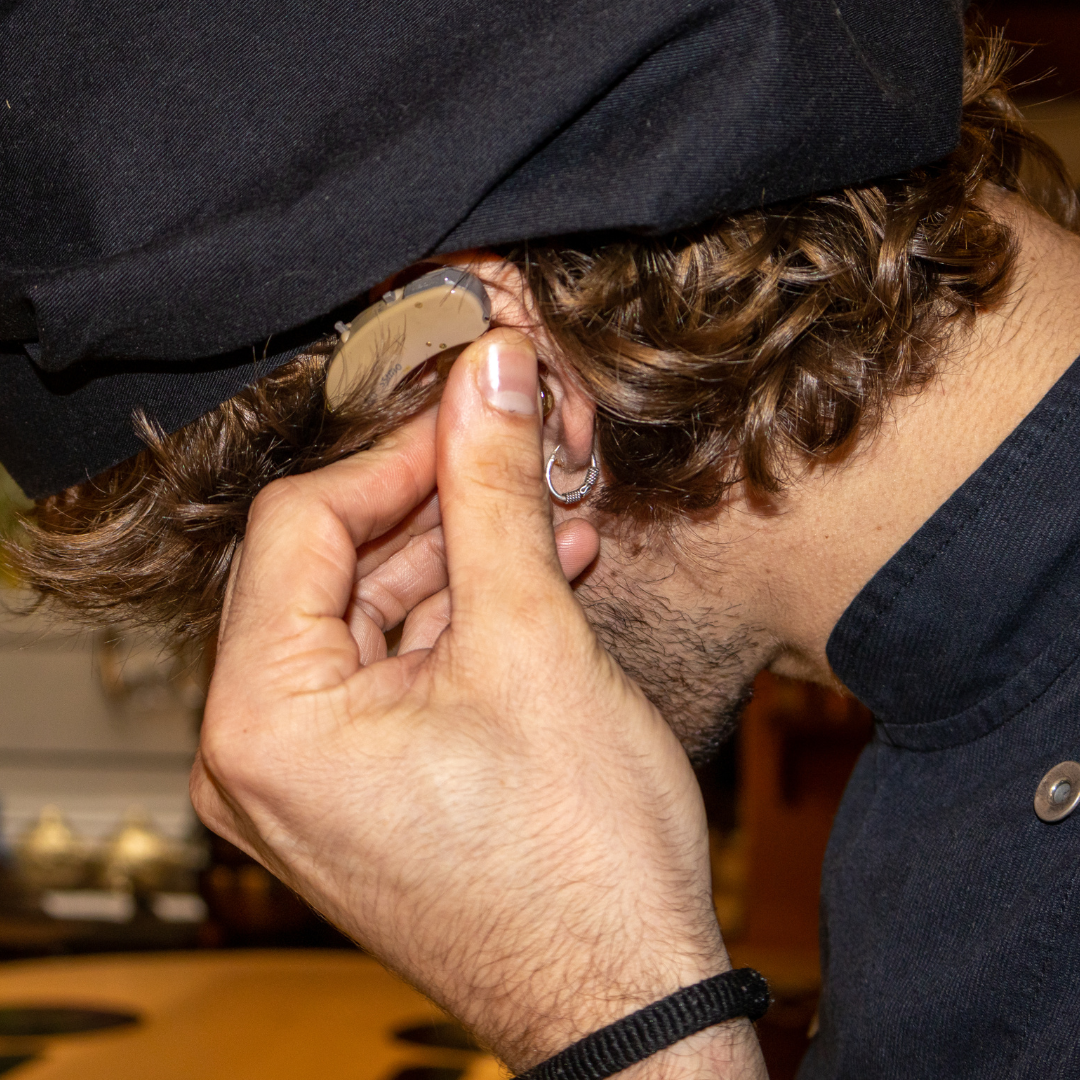
Selecting the ideal assistive technology depends upon underlying diagnosis, specific acoustic challenges, and verified hearing loss. Modern clinical hearing aids integrate directional microphone polar patterns, automated digital noise suppression, and personalized restaurant memory settings to highlight frontal speech and reduce background competition. Patients must uphold realistic expectations because modern amplification cannot strip out every ambient human voice completely.
A remote microphone can provide a stronger improvement in the signal-to-noise ratio. Positioned near or clipped to the speaker, the device transmits raw speech audio directly to paired hearing aids or external listening receivers. This strategy bypasses the detrimental effects of room reverberation, distance, and localized background chatter.
Additional effective assistive technologies include:
- Table microphones for small-group conversations
- Hearing-loop telecoils that stream clean audio in loop-equipped establishments
- Mobile speech-to-text applications delivering instant visual captions during dinner
- Modern wireless hearables delivering directional beamforming and sound enhancement
- Acoustic sound-meter apps and dining review directories that score restaurant noise
Our audiology staff helps you evaluate options, ensures wireless compatibility, and trains you on operating your chosen equipment.
How Can a Doctor Help with Hearing in Loud Places?
A hearing evaluation can move the conversation beyond “I hear fine in quiet.” We can review the places, speakers, and noise levels that cause problems and select tests that reflect those concerns. The assessment may include pure-tone thresholds, middle-ear testing, word recognition, and speech-in-noise measures. Diagnostic auditory-processing testing may be recommended if your clinical symptoms and baseline evaluations suggest central auditory dysfunction.
Sudden unilateral hearing drops, acute asymmetric changes, or rapid auditory decline mandate evaluation by an ear, nose, and throat physician. Personalized care identifies the source of the difficulty rather than assuming restaurant noise is the only problem.
Contact Us for a Hearing Evaluation Today
If restaurant conversations leave you guessing, withdrawing, or feeling exhausted, schedule a comprehensive hearing evaluation with us. Our specialists can introduce effective interventions to support your hearing in noisy environments via precision hearing aid fittings, assistive devices, or audiological rehabilitation.
Get in touch with our team to request an appointment and rediscover confident, stress-free restaurant conversations.